Tag: Retirement Income

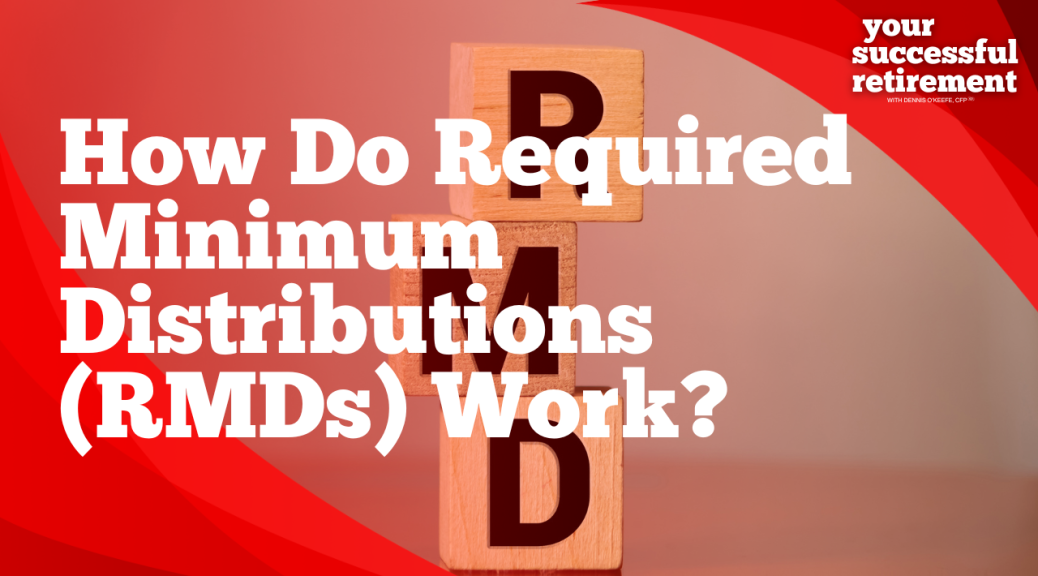
How Do Required Minimum Distributions (RMDs) Work?

How Do Required Minimum Distributions (RMDs) Work?

Required minimum distributions often sound straightforward until timing, taxes, and deadlines begin affecting the decisions you make.

Many retirees discover there is more flexibility than they expected, but there are also situations where delaying a distribution can create unintended tax consequences.

In this YSR FAQ episode, Dennis O’Keefe explains how required minimum distributions are calculated, when they begin, and why understanding the rules before your first distribution matters. He discusses the option to delay your initial RMD, why that choice doesn’t always produce a better outcome, how taking two distributions in one year can increase taxable income, and what retirees should consider before deciding when to withdraw their money.

Key takeaways:

  • How required minimum distributions are calculated using your prior year account balance
  • Why your first RMD may be delayed, but rarely produces the best tax outcome
  • How taking two distributions in one year can increase taxable income
  • When brokerage firms notify retirees about annual distribution requirements
  • Why planning ahead reduces unnecessary tax surprises during retirement
  • And more!

Connect with Dennis O’Keefe: 

All content presented is for educational purposes only and should not be construed as an endorsement of any third party, or as a solicitation or offer to sell securities or provide investment, tax, legal, or consulting services, and should not be acted upon without obtaining specific advice from a qualified professional. We believe the information presented to be reliable, but it is not guaranteed as to its accuracy or completeness. All examples are hypothetical and for illustrative purposes only. Any opinions or statements by third parties are their own and may not be representative of the experience of others or indicative of future investment performance or success. No compensation has been exchanged for any testimonials, endorsements, and/or recognitions.
How Do You Know Your Tax Bracket and Why Does It Matter?

How Do You Know Your Tax Bracket and Why Does It Matter?

Many financial decisions feel unrelated until taxes quietly change the outcome.

Knowing where your income falls can influence everything from retirement withdrawals to Roth conversions, yet many people don’t realize how much flexibility they actually have.

In this YSR FAQ episode, Dennis O’Keefe explains why understanding your tax bracket is one of the most valuable habits you can build before making financial decisions. He walks through the largest jumps in the current tax code, explains how those changes affect Roth conversions, capital gains, and retirement withdrawals, and shares a simple way to find reliable tax information without memorizing complicated IRS tables. He also explains why keeping a current tax reference guide nearby can make planning easier throughout the year.

Key takeaways:

  • How larger jumps between tax brackets can affect retirement withdrawals and investment decisions
  • Why Roth conversion amounts often depend on the available room before the next bracket
  • How capital gains taxes change based on your taxable income
  • Where to find a reliable annual tax reference guide in just a few minutes
  • Why understanding your tax bracket helps you make more informed financial choices
  • And more!

Connect with Dennis O’Keefe: 

All content presented is for educational purposes only and should not be construed as an endorsement of any third party, or as a solicitation or offer to sell securities or provide investment, tax, legal, or consulting services, and should not be acted upon without obtaining specific advice from a qualified professional. We believe the information presented to be reliable, but it is not guaranteed as to its accuracy or completeness. All examples are hypothetical and for illustrative purposes only. Any opinions or statements by third parties are their own and may not be representative of the experience of others or indicative of future investment performance or success. No compensation has been exchanged for any testimonials, endorsements, and/or recognitions.

Is It Worth It To Convert Your IRA To A Roth?

Is It Worth It To Convert Your IRA To A Roth?

Should you convert your traditional IRA to a Roth IRA? In this YSR FAQ episode, Dennis O’Keefe breaks down the pros and cons of Roth conversions and explains why the answer depends heavily on your tax situation.

Dennis discusses how Roth conversions are taxed, the importance of understanding tax brackets, and why many investors benefit from a multi-year conversion strategy rather than making one large move. He also examines some of the common misconceptions surrounding Roth conversions and why generic online calculators can sometimes produce misleading results.

For those thinking about tax-efficient retirement income or leaving assets to the next generation, this episode provides valuable insight into when a Roth conversion may, or may not, be beneficial.

Key takeaways:

  • How Roth conversions work
  • Why tax brackets are critical to the decision
  • Potential tax pitfalls to avoid
  • Multi-year conversion strategies
  • The estate planning benefits of Roth assets
  • And more!

Connect with Dennis O’Keefe: 

All content presented is for educational purposes only and should not be construed as an endorsement of any third party, or as a solicitation or offer to sell securities or provide investment, tax, legal, or consulting services, and should not be acted upon without obtaining specific advice from a qualified professional. We believe the information presented to be reliable, but it is not guaranteed as to its accuracy or completeness. All examples are hypothetical and for illustrative purposes only. Any opinions or statements by third parties are their own and may not be representative of the experience of others or indicative of future investment performance or success. No compensation has been exchanged for any testimonials, endorsements, and/or recognitions.

How Much Money Do I Need For Retirement?

How Much Money Do I Need For Retirement?

One of the most common retirement questions is also one of the hardest to answer: How much money is enough? 

In this YSR FAQ episode, Dennis O’Keefe explains why there is no universal retirement savings target and why your spending habits matter far more than a simple rule of thumb.

Dennis shares a real-life example of two workers with dramatically different retirement account balances and reveals why the person with less money was actually in a better position to retire. He also walks through how retirement income, pensions, Social Security, debt obligations, and lifestyle choices all factor into the equation.

If you’re trying to determine whether you’re financially ready for retirement, this episode highlights the importance of understanding your true spending needs before relying on generic retirement benchmarks.

Key takeaways:

  • Why retirement savings rules of thumb can be misleading
  • The difference between income and spending
  • How pensions and Social Security affect retirement readiness
  • A simple way to estimate your retirement spending needs
  • And more!

Connect with Dennis O’Keefe: 

All content presented is for educational purposes only and should not be construed as an endorsement of any third party, or as a solicitation or offer to sell securities or provide investment, tax, legal, or consulting services, and should not be acted upon without obtaining specific advice from a qualified professional. We believe the information presented to be reliable, but it is not guaranteed as to its accuracy or completeness. All examples are hypothetical and for illustrative purposes only. Any opinions or statements by third parties are their own and may not be representative of the experience of others or indicative of future investment performance or success. No compensation has been exchanged for any testimonials, endorsements, and/or recognitions.
Should I Be Doing This Annuity?

Should I Be Doing This Annuity?

Should you consider an annuity, or avoid it altogether? 

This week, Dennis O’Keefe breaks down how annuities work, why they are often sold rather than bought, and when they may or may not make sense.

Using a real client scenario, Dennis explains how annuity proposals can be positioned in ways that don’t always benefit the investor. He also walks through the structure of annuities, including insurance components, tax deferral, and the underlying costs that can impact returns.

Key takeaways:

  • What an annuity actually is
  • Why annuities tend to be expensive
  • How commissions and structure impact recommendations
  • When annuities may make sense
  • Why a second opinion can be critical
  • And more! 

Connect with Dennis O’Keefe: 

All content presented is for educational purposes only and should not be construed as an endorsement of any third party, or as a solicitation or offer to sell securities or provide investment, tax, legal, or consulting services, and should not be acted upon without obtaining specific advice from a qualified professional. We believe the information presented to be reliable, but it is not guaranteed as to its accuracy or completeness. All examples are hypothetical and for illustrative purposes only. Any opinions or statements by third parties are their own and may not be representative of the experience of others or indicative of future investment performance or success. No compensation has been exchanged for any testimonials, endorsements, and/or recognitions.

Understanding Social Security: Myths, Mechanics, and What Happens Next

Understanding Social Security: Myths, Mechanics, and What Happens Next

Many people think they understand Social Security, until conflicting answers and uncertainty create confusion.

What’s actually true about how benefits work, and what should you expect in the years ahead?

In this episode, Dennis O’Keefe breaks down how Social Security really works and clears up common misconceptions. He explains how benefits are calculated, why the system is often misunderstood, and what the projected shortfall around 2032 could mean. Dennis also explores how policy changes like tax increases or benefit adjustments may shape the future, helping listeners better understand their options and expectations.

Key takeaways:

  • How spousal and dependent benefits can increase total Social Security income when coordinated properly
  • Why Social Security is structured as an insurance program rather than a personal retirement account
  • How the Social Security Trust Fund works and why funds are being drawn down over time
  • The real reason behind the projected 2032 shortfall and what it means for future benefits
  • Potential changes like higher payroll taxes or income-based benefits that could reshape the system
  • And more!

Connect with Dennis O’Keefe: 

All content presented is for educational purposes only and should not be construed as an endorsement of any third party, or as a solicitation or offer to sell securities or provide investment, tax, legal, or consulting services, and should not be acted upon without obtaining specific advice from a qualified professional. We believe the information presented to be reliable, but it is not guaranteed as to its accuracy or completeness. All examples are hypothetical and for illustrative purposes only. Any opinions or statements by third parties are their own and may not be representative of the experience of others or indicative of future investment performance or success. No compensation has been exchanged for any testimonials, endorsements, and/or recognitions.